

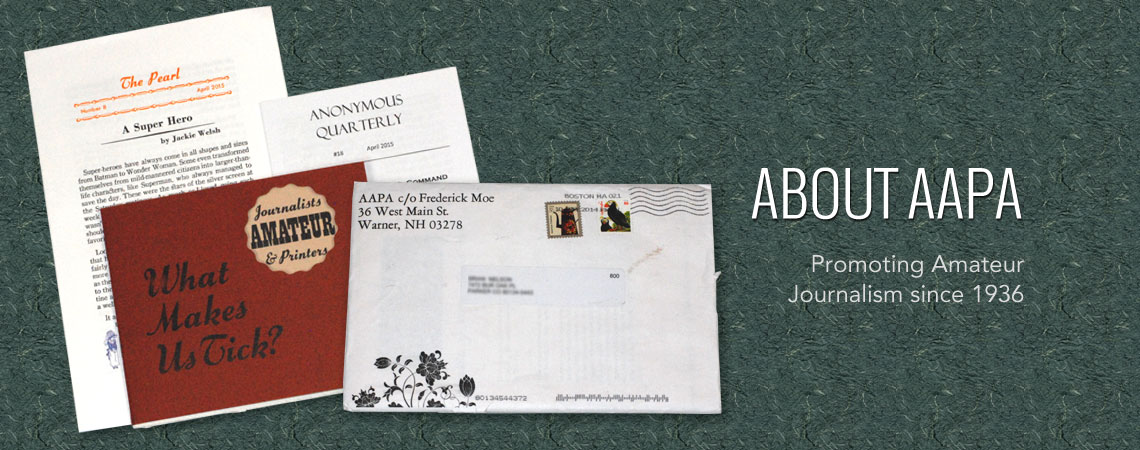
The American Amateur Press Association is a nation-wide non-profit organization of amateur journalists founded in 1936. The purpose of the association is the promotion of amateur journalism and fellowship of amateur writers, editors, printers, and publishers; and the circulation of their work among the membership.
We currently have about 150 members and are always on the lookout for others who share an interest in our hobby.
The answer to this question is an elusive one because amateur journalism is many things to many people.
It is publishing a little journal or zine containing your own ideas and thoughts on a variety of subjects and having it distributed to fellow "ajays." It is composing your own essay, poem, or short story and seeing it published in another member's paper. It is producing a paper from copy provided by others, just because you love to publish.
The end product is the amateur journal, a zine that might take any form. It could range from a tiny, whimsical "thumbnail" in size to a deluxe, deckle-edged heavyweight.
There is no price tag on anything, for we interpret "amateur" to mean untainted by commercial profit interests (although we have some professional journalists and printers who enjoy taking part in the AAPA on a no-deadlines hobby basis). We write and publish to please ourselves and each other.
The roots of amateur journalism go back into the nineteenth century, when several models of tabletop printing presses became available. Teenagers were encouraged to make money in their spare time by purchasing the equipment and supplies to set up a small shop. In addition to completing small printing jobs, some of the printers found time to publish papers. They began exchanging journals with one another, then formed regional and national organizations to provide a framework for activity.
Although AAPA papers are published using many different methods, some current AAPA members have hobby print shops that use hand-set type and hand- or foot- operated presses.
Computer-generated amateur journals began appearing in the early 1980s, and an increasing number of members use home computers to produce their papers. Some publishers combine the old and the new; for example, using letterpress equipment to add color headings to an offset-printed journal that was laid out with a desktop publishing program.
The AAPA is non-profit, but we charge $25 annual dues to provide a few services, including:
We're an informal, peer-run club. Our officers are elected by mail. We have no permanent headquarters, no big operating fund, no big endowment. AAPA is just an organization of people with a passion for the printed word.
The hobby of amateur journalism is difficult to explain in detail, and most people need to experience it to determine whether it's a hobby they can enjoy. Here are a few indications that you might enjoy membership in the AAPA:
The AAPA has retirees, teenagers, college students, professional journalists and printers, professors, truck drivers, ministers, you name it—just ordinary people with an extraordinary hobby. Join us, and get acquainted!
In the summer of 2017, member Michael Coughlin wrote two articles describing features of AAPA:
How Do Writers Find Readers?
Blogging vs Publishing
The American Amateur Press Association Constitution and By-Laws is available online.
You can view examples of amateur journalism.
There's also a page of frequently asked questions from visitors to the AAPA's website.
If you have questions that aren't answered on our website, please contact us.
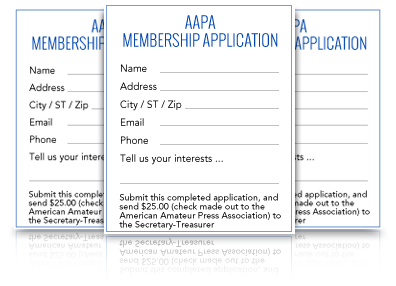
If you are ready to become an AAPA member, here's a page with information on how to join, including an application form.
The website of The Fossils presents an extract from Truman Spencer's History of Amateur Journalism describing the formation and early years of the AAPA.
 Amateur journalism is a unique activity. Amateur journalists publish journals on paper & online & come from many perspectives: from deluxe letterpress printed journals, to Xeroxed newsletters, to artistically designed cards and ephemera. We embrace the spirit of being amateurs – loving what we do for pure joy and not financial gain – while creating top quality journals, zines, and homemade publications.


 |
|